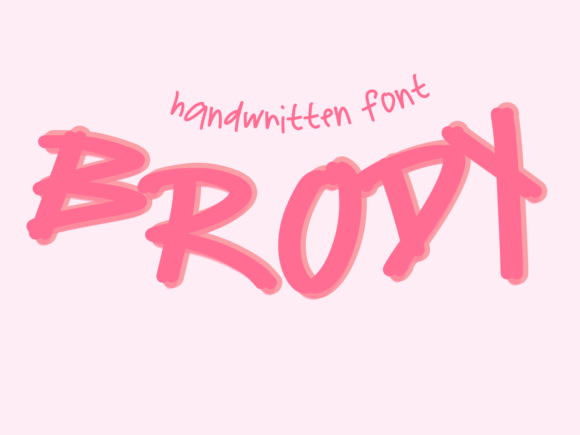
Brody: A Playful Font with Serious Creative Potential
There’s a certain kind of warmth you can’t fake in design. It’s the feeling of a handwritten note on a birthday card, the friendly curve of a child’s drawing, the uncomplicated joy of something made with care. Capturing that feeling in a digital format is a challenge many designers and creators face. You want your work to feel approachable, human, and full of personality, but it also needs to be polished and professional. This is where a thoughtfully crafted typeface can do the heavy lifting. Enter Brody, a childish, easy-to-read display font that conveys impeccable friendliness. It’s not just a collection of letters; it’s a visual voice that speaks directly to the heart, making it a surprisingly versatile tool for a wide range of creative and commercial projects.
More Than Just a Cute Face: The Visual DNA of Brody
At first glance, Brody’s appeal is obvious. Its letterforms are soft, rounded, and slightly irregular, mimicking the charming imperfections of hand-lettering. This isn’t a sterile, geometric sans serif font; it has a pulse. The gentle curves and open counters give it an inherent legibility, even at larger display sizes where its personality truly shines. Think of it as the typographic equivalent of a warm smile—it immediately puts the viewer at ease.
But calling it merely “cute” would be an undersell. The genius of a premium font like Brody lies in its balance. The childish aesthetic is executed with professional precision. The kerning and spacing are carefully considered, ensuring that words flow together naturally without awkward gaps or collisions. This attention to detail is what separates a professional design asset from a free, often poorly constructed, alternative. It’s this blend of whimsy and technical polish that makes Brody a reliable choice for projects where first impressions and brand recognition are paramount.
Where Friendliness Meets Function: Practical Applications
The true test of any creative font is its real-world utility. Where does a typeface with such a distinct personality actually work? The answer might surprise you with its breadth. Brody’s strength is in its ability to inject warmth and approachability without sacrificing clarity.
For Branding and Logo Design: If your brand targets families, children, pet owners, or the food and craft markets, Brody can be the cornerstone of your visual identity. Imagine a logo for a local bakery, a children’s boutique, or a community yoga studio. Brody sets a tone that is welcoming and trustworthy. It tells customers, “We’re friendly, we’re approachable, and we care.”
For Packaging and Merchandise: On a shelf crowded with products, a friendly face stands out. Using Brody on packaging for organic snacks, artisanal goods, or handmade soaps can create an instant emotional connection. It translates beautifully onto merchandise like tote bags, t-shirts, and mugs, where its playful style feels right at home.
Digital and Print Presence: The applications extend far beyond physical products. Consider the impact on your digital footprint. A social media graphic using Brody for a call-to-action feels more like a friendly suggestion than a hard sell. In web design, it can be used for headers or featured quotes to break up dense text and guide the reader’s eye with a cheerful touch. For print materials like flyers, posters, or event invitations, it guarantees your message feels personal and engaging, not corporate and cold.
Building a Cohesive Visual Language
Consistency is the bedrock of professional design. Using a single, versatile font family across multiple touchpoints creates a unified brand experience that builds trust and recognition. This is where reviewing the included font styles becomes crucial. A well-designed display font often comes with variations—perhaps a regular weight, a bold, and sometimes an italic or a slightly different stylistic alternative.
For instance, you might use Brody Bold for main headlines to grab attention, the regular weight for subheadings, and reserve its use for key phrases on your website or in a blog post. This creates a clear visual hierarchy while maintaining that signature friendly tone. The key is to match the typography to your project’s goal. Is the primary objective to be inviting? To be playful? To be clear and easy to digest? Brody answers “yes” to all three, but how you deploy its styles will fine-tune that message.
The Art of the Pair: Testing Font Combinations
No font is an island. While Brody is a standout performer, its power is often amplified when paired thoughtfully with other typefaces. A common and effective strategy is to contrast a distinctive display font with a more neutral body text font. This ensures readability for longer passages while allowing the personality of the display font to lead the visual conversation.
Consider pairing Brody with a clean, simple sans serif font for body copy. The contrast creates a dynamic yet balanced look—the friendly warmth of Brody for headlines is grounded by the clean efficiency of the sans serif for paragraphs. For a different feel, you could pair it with a classic, readable serif font, which might lend a touch of timeless sophistication to the overall layout. The goal of font pairing is not to find two fonts that are identical, but two that complement each other, creating a harmonious visual system for your brand identity or editorial design.
A Practical Checklist for Using Brody
Before you dive into your next project with this typeface, keep a few practical considerations in mind to ensure you get the most out of it.
- Readability First: Always test your text at the size it will be viewed. While Brody is highly legible for a display font, it’s designed for impact, not for 10-point body text in a long-form report. Use it for headlines, logos, and short bursts of text where its character can be fully appreciated.
- Licensing Matters: For any project that will be sold or used for commercial gain, from a client’s logo to merchandise, you must ensure you have the correct commercial license. This is a non-negotiable part of using any professional design asset and protects both you and the font’s creator.
- Context is Key: The “childish” quality is an asset in the right context. It would be perfect for a pediatrician’s office but likely inappropriate for a law firm’s annual report. Always align your font choice with the core message and audience of your project.
- Experiment with Pairings: Don’t just settle on the first combination you try. Mock up a few different layouts with Brody alongside potential body fonts. Seeing them together in context is the only way to truly judge their synergy.
In the end, choosing a typeface is a creative decision that has strategic implications. Brody offers more than just a playful aesthetic; it provides a tool for communication that is rooted in warmth and accessibility. It’s a reminder that professionalism doesn’t have to mean cold, and that friendliness can be a powerful design strategy. For the designer, the entrepreneur, or the crafter looking to make their work feel a little more human, this font might just become that reliable, go-to favorite for years to come.